
Screen Printing vs Pad Printing for Industrial Parts
A logo, warning, scale, serial legend, or operating symbol has to remain clear after the part leaves the printing station and enters daily use. The printing method should match the surface, image, ink, volume, and durability requirement.
Screen printing and pad printing can both mark metal, plastic, glass, and coated parts. Their strengths differ when the part is curved, recessed, textured, or very small.
Screen Printing Works Well on Broad, Accessible Surfaces
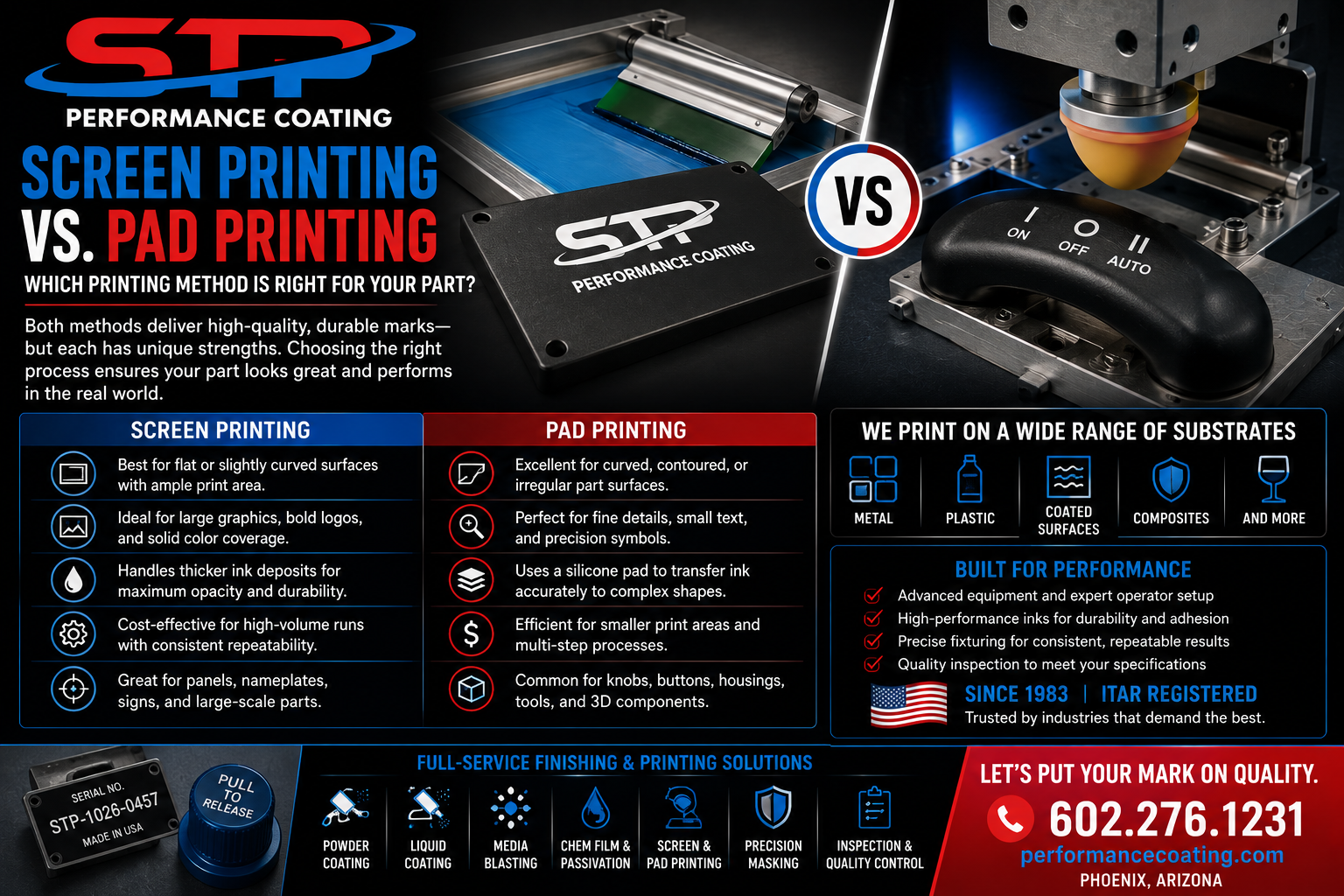
Screen printing pushes ink through a stenciled mesh onto the part. It is a strong choice for flat or gently curved surfaces with enough room for the screen, squeegee, and fixture.
The process can lay down a bold, opaque image and works well for panels, nameplates, enclosures, signs, and larger legends. Repeated production runs can be efficient once the screen, ink, and fixture are established.
The screen needs consistent contact with the print area. Deep recesses, abrupt curves, raised ribs, and nearby hardware can prevent the mesh from reaching the surface evenly.
Pad Printing Reaches Curved and Irregular Parts
Pad printing transfers ink from an etched plate to the product using a flexible silicone pad. The pad deforms as it contacts the part, allowing it to reach shapes that are difficult for a screen.
This makes pad printing useful for knobs, buttons, handles, housings, medical components, tools, and other three dimensional products. Fine text and small symbols can be reproduced when the artwork, plate, pad, ink, and fixture are correctly matched.
The image area is usually smaller than a typical screen printed graphic. Large solid fields may be better suited to screen printing or another process.
Part Geometry Should Lead the Decision
Begin with the exact print location. A flat control panel may favor screen printing. A symbol wrapped over a compound curve may require pad printing.
Measure the available image area and note nearby walls, bosses, holes, and edges. Provide a three dimensional model or sample part when the geometry is difficult to show on a drawing.
The part must be held in the same position for every cycle.
Ink Must Match the Substrate and Finish
Ink that adheres to bare metal may not perform the same way on powder coating, liquid paint, plastic, glass, rubber, or a low surface energy material. The printer needs to know the substrate and any coating already applied.
Some inks require a hardener, primer, heat cure, or extended room temperature cure before reaching full resistance.
A successful sample on one finish does not automatically approve a different color, resin, or supplier. Changes to the underlying coating should be communicated before production.
Artwork and Color Requirements Affect Setup
Supply vector artwork whenever possible. Identify the exact size, location, orientation, font, line weight, and color standard. Very small text or narrow gaps may need adjustment so the finished mark remains readable.
Each spot color normally requires separate setup and registration. A simple one color legend is easier to repeat than a complex multicolor design.
Approved samples are valuable when appearance matters. Keep the accepted sample and artwork revision connected to the part number for future orders.
Test the Mark for Its Real Environment
A printed image can look correct and still fail in service. Define the required checks before the lot is released.
Depending on the application, testing may include adhesion, abrasion, solvent resistance, cleaning chemical exposure, heat, humidity, or repeated handling. The customer should specify the method and acceptance criteria rather than asking for a mark that is merely “durable.”
Allow the ink to complete its required cure before testing or packaging. Ink manufacturers may specify different curing periods, mixing ratios, and resistance limits for each substrate and ink system.
Arrange Screen and Pad Printing With STP Performance Coating
STP Performance Coating provides screen printing, pad printing, powder coating, liquid coating, precision masking, and related industrial finishing services in Phoenix. Call 602 276 1231 with the part sample or drawing, substrate, coating, artwork, colors, quantity, print location, and testing requirements so the right printing method can be selected before production begins.