
Chem Film vs Anodizing: Which Aluminum Finish Fits the Part?
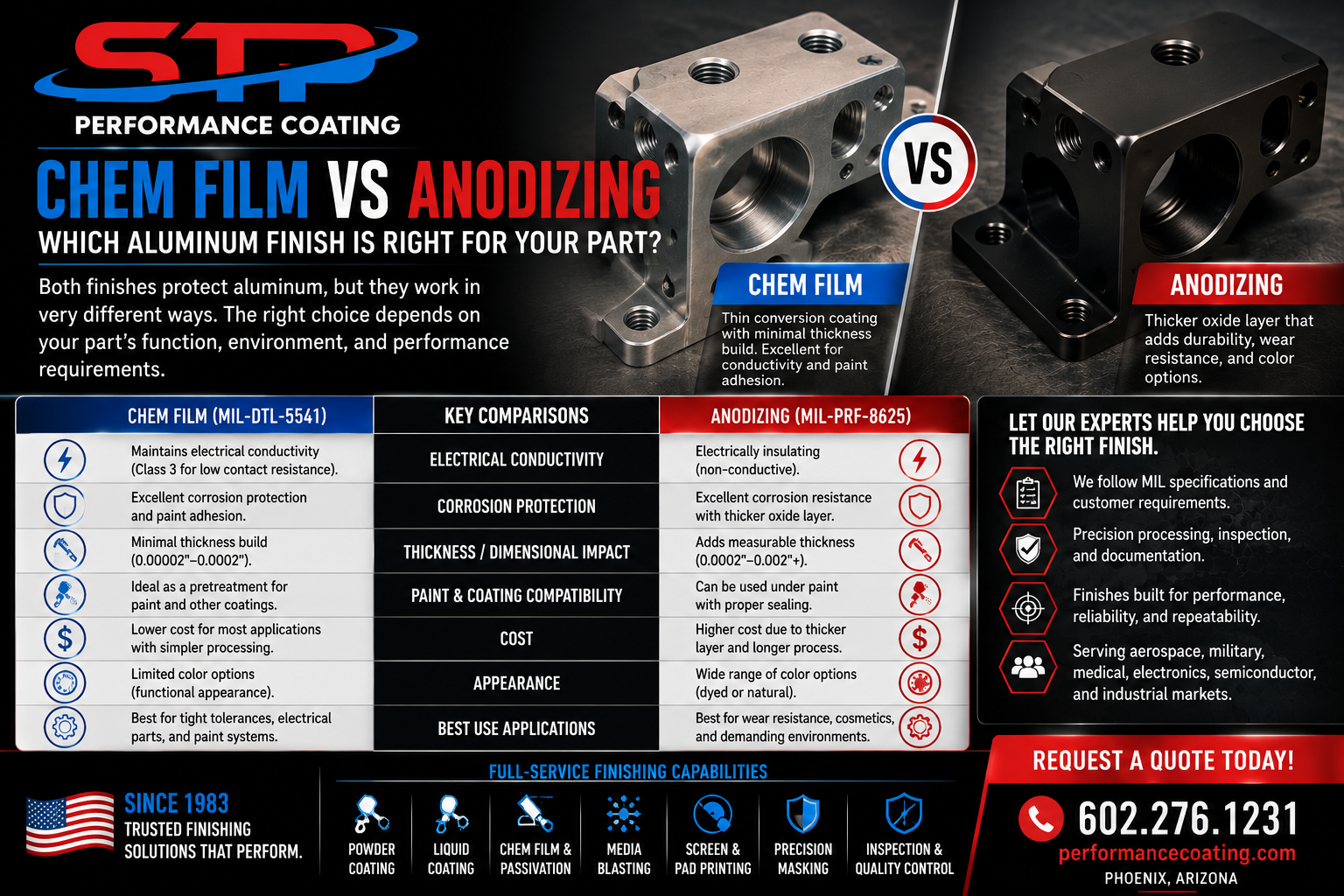
Chem film and anodizing both protect aluminum, but they do not create the same surface. Choosing between them from appearance alone can lead to trouble when a part needs electrical conductivity, paint adhesion, wear resistance, color, or tight dimensional control.
The drawing should identify the required process and specification. When the design is still open, the part’s function should decide which finish makes sense. MIL DTL 5541 governs chemical conversion coatings, while MIL PRF 8625 covers several anodic coating types and classes.
Chem Film Creates a Thin Conversion Coating
Chem film, also called chemical conversion coating, forms through a chemical reaction with the aluminum surface. MIL DTL 5541 covers chemical conversion coatings on aluminum and aluminum alloys.
The resulting film is extremely thin. It adds little measurable thickness, which makes it useful on close tolerance parts where a heavier finish could affect fit. Chem film is commonly specified as Class 1A for corrosion protection and paint preparation or Class 3 where lower electrical resistance is important.
The surface may appear clear, iridescent, yellow, brown, or gray depending on the type and process. It is generally chosen for function rather than a decorative finish.
Anodizing Builds a Thicker Oxide Layer
Anodizing is an electrochemical process that grows a controlled aluminum oxide layer from the base metal. MIL PRF 8625 covers several types and classes of anodic coatings for nonarchitectural aluminum parts.
The layer is thicker and harder than chem film. It can provide greater resistance to wear and abrasion and may be dyed when the specification allows. Hardcoat anodizing is used when the surface needs more demanding wear performance.
Anodizing changes part dimensions because the oxide grows both into and above the original surface. Critical bores, threads, fits, and sealing areas must be considered on the drawing.
Electrical Conductivity Often Decides the Choice
Anodic oxide is electrically insulating. That can be useful in some assemblies, but it can interfere with grounding, bonding, or electrical contact.
Chem film is often selected for electrical enclosures, housings, and contact areas because it can preserve useful conductivity while adding corrosion protection. Class 3 is commonly associated with applications where lower contact resistance matters.
Do not assume the entire part needs one finish. A design may use anodizing for overall durability while protecting or separately treating specific contact areas.
Paint Adhesion and Corrosion Needs Matter
Chem film is widely used as a pretreatment beneath paint or other organic coatings. It prepares the aluminum surface while helping protect exposed areas from corrosion.
Anodizing can also support corrosion resistance, but paint systems over anodized surfaces require the correct process and specification. Sealing, surface condition, and the intended topcoat all matter.
When the part will be painted, tell the finisher which primer and topcoat follow the conversion coating. A finish selected in isolation may not work as intended within the complete system.
Wear and Appearance Favor Anodizing
A frequently handled component, sliding surface, tool, or exposed consumer part may benefit from anodizing because the oxide layer is harder and more resistant to wear.
Chem film is not intended to provide the same abrasion resistance. It can be scratched or worn more easily, particularly when used without a topcoat.
Color is another difference. Anodizing can create durable decorative colors, while chem film normally has a limited functional appearance. If exact color and gloss are important, provide a specification and approved sample.
Follow the Specification on Controlled Work
Aerospace, defense, medical, electronics, and semiconductor parts may have a required standard, type, class, test method, and approved processor. Substituting chem film for anodizing, or the reverse, is an engineering change rather than a purchasing convenience.
Use the current drawing revision. Identify masking, rack points, conductivity areas, thickness limits, testing, and certification requirements before sending the parts.
Request Chem Film Services From STP Performance Coating
STP Performance Coating provides chem film processing for aluminum parts, including work governed by MIL DTL 5541 and customer specifications, along with masking, painting, powder coating, and inspection services. Call 602 276 1231 with the alloy, drawing, class, quantity, testing requirements, and intended next process to request a Phoenix chem film quote.
Live References
STP Performance Coating Chem Film Services
Defense Logistics Agency: MIL DTL 5541
Defense Logistics Agency: MIL PRF 8625
North American Metal Finishings: Chem Film vs Anodize
Best Technology: Alodine vs Anodize