

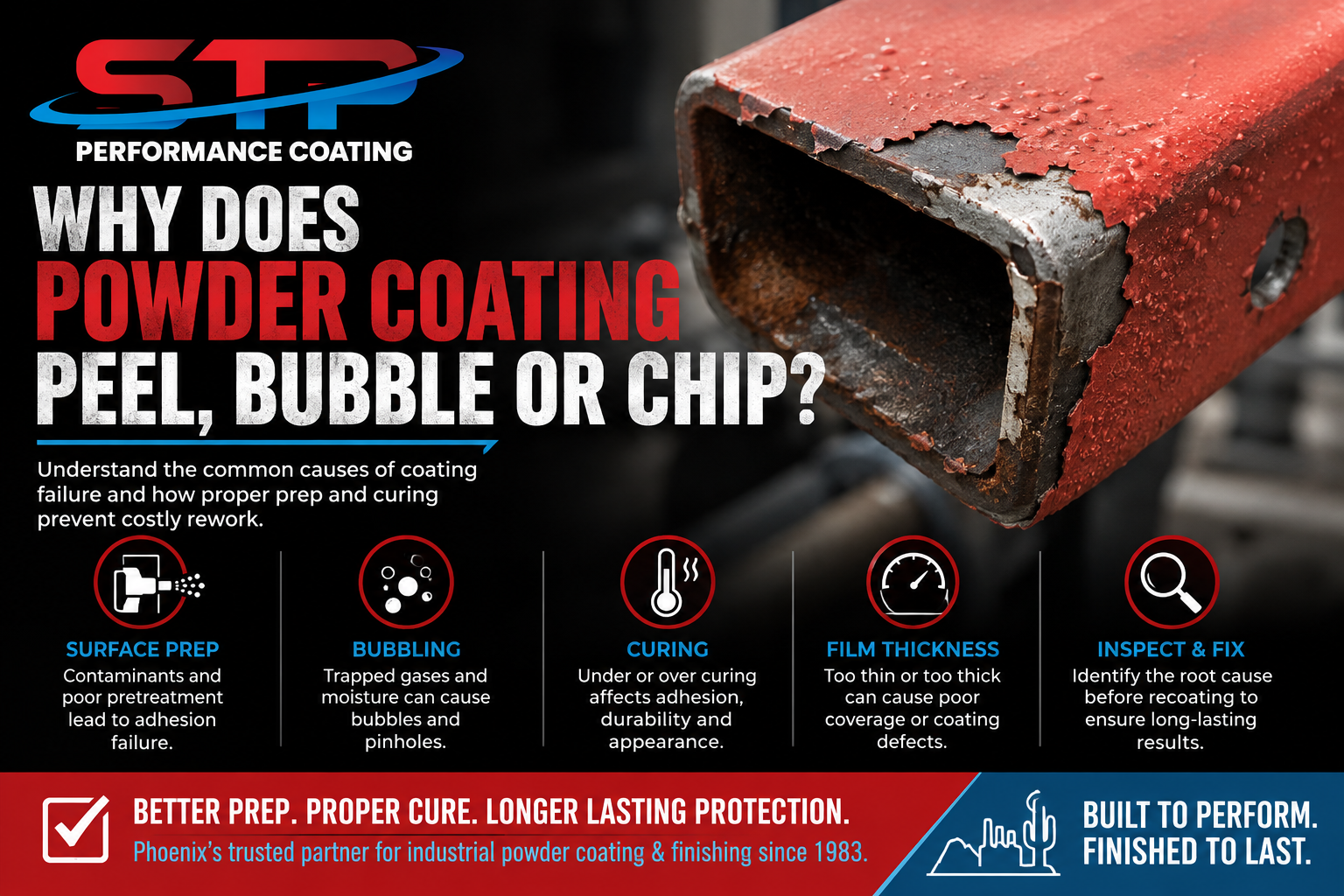
Why Does Powder Coating Peel, Bubble or Chip?
Powder coating is known for producing a durable finish, so peeling, bubbling or early chipping usually points to a problem in preparation, application or curing. The powder itself is only one part of the system.
For manufacturers, fabricators and equipment owners in Phoenix, finding the actual cause matters before parts are stripped and coated again. Repeating the same process without correcting the underlying issue can produce the same failure twice.
Surface Preparation Comes First
Powder needs a clean, properly prepared substrate. Oil, grease, oxidation, mill scale, old coating and other contaminants can interfere with adhesion.
TIGER Coatings notes that pretreatment and rinsing directly affect coating adhesion and corrosion resistance. Residue left on the surface can weaken the finished coating even when the powder application looks normal at first.
Abrasive blasting, cleaning and chemical pretreatment may all be appropriate depending on the metal and specification. STP Performance Coating has onsite media blasting capability as part of its broader finishing operation.
Peeling Often Points to Adhesion Trouble
When coating separates from the substrate in sheets or flakes, poor adhesion should be investigated.
Surface contamination is one possible cause. Insufficient pretreatment is another. The coating may also have been under cured, meaning the part did not receive the time and temperature needed for the powder to develop its intended properties.
TCI Powder Coatings lists both insufficient surface preparation and under curing among potential causes of poor adhesion. A finished surface should not be judged only by appearance.
Bubbles and Pinholes Can Come From Outgassing
Some castings and porous metals contain trapped gases or contaminants. When the part is heated during cure, those gases can escape through the coating and leave bubbles or small pinholes.
Sherwin Williams identifies trapped air in porous surfaces as a possible cause of pinholing. Excessive film thickness and improper oven conditions can also contribute.
Depending on the substrate, a processor may use a pre bake, alter the cure schedule or select a coating designed to tolerate outgassing. Applying another coat over the defect without dealing with the source is unlikely to provide a lasting repair.
Film Thickness Has to Match the Specification
More coating is not automatically better.
A film that is too thin may provide poor coverage or fail to deliver the required protection. A film that is too thick can create appearance problems and may become more brittle.
TCI identifies excessive film thickness as a possible cause of poor adhesion and pinholing. Performance Coating also asks customers to identify critical maximum coating thickness requirements when they are not otherwise controlled by the project specification.
Threads, mating surfaces and tight tolerance areas deserve attention because added coating can affect fit.
Cure Depends on Part Temperature
The oven air temperature does not tell the whole story. The metal part itself has to reach the required cure temperature and remain there for the specified time.
Heavy components can take longer to heat than small thin parts. Under curing may leave the finish looking acceptable while its mechanical properties remain below expectations. Over curing can also affect appearance or color.
A controlled process considers part mass, oven profile and the powder manufacturer’s technical data rather than using one timing assumption for every job.
Inspect the Failure Before Recoating
Before stripping a failed finish, look at where the problem began.
Is the coating separating from bare metal? Are bubbles concentrated around cast areas or welds? Is damage limited to an impact zone, or spreading across the entire part?
Those details help distinguish application failure from ordinary mechanical damage and give the coating processor useful information before a new finishing plan is chosen.
Get Professional Powder Coating in Phoenix
STP Performance Coating, LLC has provided industrial finishing services in Phoenix since 1983, with powder coating, liquid coating, media blasting, complex masking and inspection capabilities for commercial, aerospace, military, medical and semiconductor work. If an existing finish is peeling, bubbling or chipping, or you need a properly specified coating for new parts, call STP Performance Coating at 602 276 1231 for a free quote and discuss the substrate, service environment and finish requirements before work begins.
References
STP Performance Coating Powder Coating Services
STP Performance Coating Quality Management
TIGER Coatings Powder Coating Pretreatment Guide